Paragon Medical’s Structured Approach to New Product Development (NPD)
Innovation in the medical device industry requires precision, efficiency, and strict adherence to regulatory standards. At Paragon Medical, we adhere to a structured
New Product Development (NPD) process to ensure rigorous development, testing, and production of new components and solutions. Our
comprehensive NPD framework integrates engineering expertise, quality assurance processes, regulatory compliance, and supply chain management to meet the highest medical industry standards.
From concept to pre-production, each phase is meticulously planned to optimize manufacturing efficiency, minimize risks, and deliver high-quality products. By following a well-defined roadmap, we provide our customers with confidence that their product will be developed, validated, and manufactured with precision.
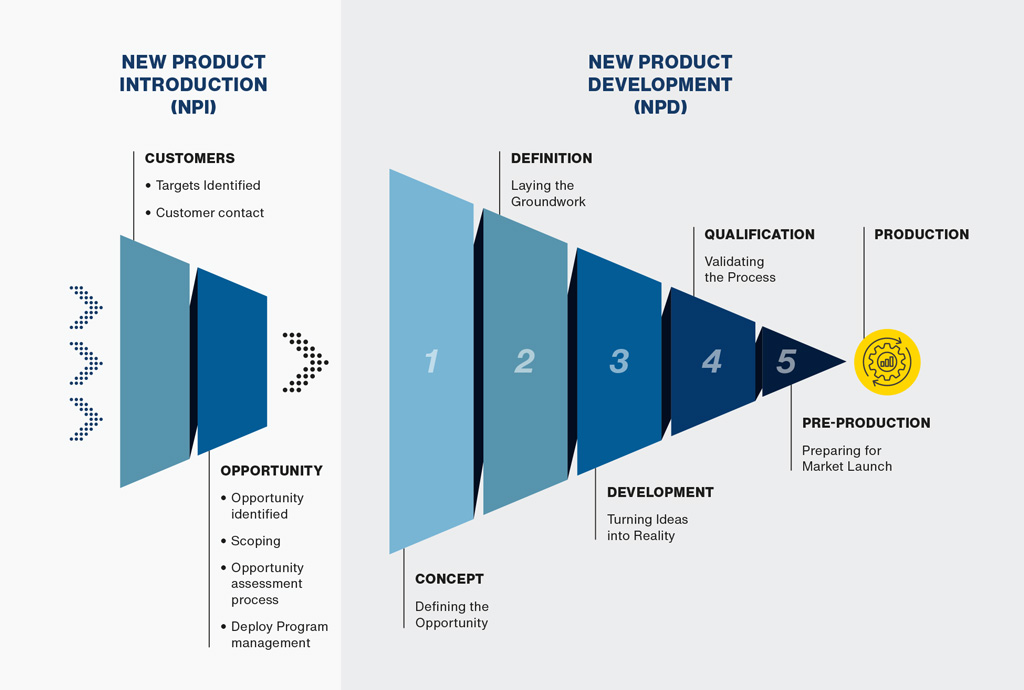
NPI: Evaluating Market Feasibility
Before a new product enters the
development phase, we conduct a
New Product Introduction (NPI) assessment. This step ensures that the product aligns with our market expertise, engineering know-how, and our manufacturing capabilities. The three key areas of evaluation include:
Market Expertise
- Understanding Demand: We conduct market analysis to determine the current landscape, competitive offerings, and demand trends.
- Defining the Product Vision: We work closely with customers to outline the product’s purpose, core functionalities, and expected market.
Technical Feasibility: Aligning with Our Capabilities
Once we confirm the market opportunity, we assess whether the product aligns with Paragon Medical’s engineering and manufacturing capabilities. This step involves:
- Reviewing material and component requirements to determine if they match our production strengths.
- Conducting preliminary design evaluations to identify potential manufacturing challenges.
- Estimating the cost and time required for production.
The Five Phases of New Product Development (NPD)
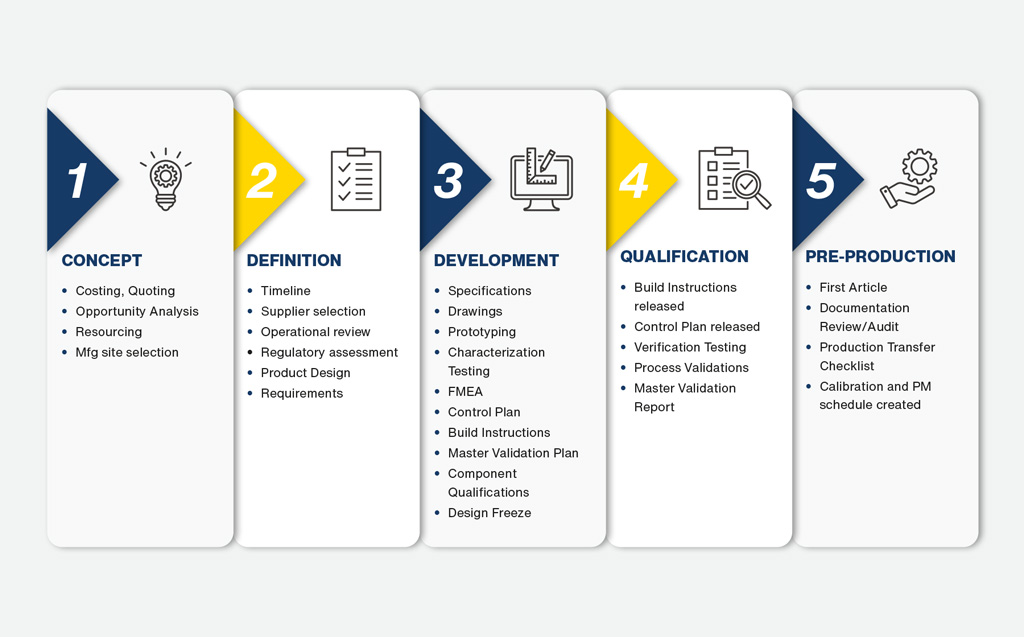 Phase 1: Concept – Defining the Opportunity
The Concept Phase marks the official beginning of the NPD process. At this stage, Paragon Medical defines the core attributes of the product and ensures alignment with market needs. Key activities in this phase include:
- Finalizing the market opportunity analysis based on sales insights and customer feedback.
- Developing an initial design concept, including CAD models and feasibility studies.
- Estimating production costs and finalizing a preliminary quote to determine profitability.
- Performing a specification review to ensure the product’s design aligns with both customer requirements and manufacturing capabilities.
This phase sets the foundation for the subsequent development stages, ensuring that the project moves forward with a well-defined scope.
Phase 2: Definition – Laying the Groundwork
Once the concept is validated, the Definition Phase focuses on planning the detailed steps required for development and production. Key steps include:
- Project Timeline Development: Setting realistic goals for each stage of production.
- Supplier and Material Selection: Identifying and validating raw material vendors.
- Capacity and Equipment Planning: Assessing in-house capabilities and determining additional resource needs.
- Regulatory Evaluation: Understanding compliance requirements related to material properties, bio-compatibility, and manufacturing conditions.
- Preliminary Design Review: Ensuring the design meets functional and regulatory expectations.
By the end of this phase, all necessary documentation, including Bill of Materials (BOM), engineering change orders (ECOs), and tooling specifications, is finalized.
Phase 3: Development – Turning Ideas into Reality
The development phase is where production trials begin. Key activities include:
- Material Procurement and Testing: Acquiring raw materials and performing quality inspections.
- Process Planning: Defining step-by-step manufacturing procedures.
- Failure Mode and Effects Analysis (FMEA): Identifying potential process risks and establishing preventive measures.
- Control Plan Development: Establishing criteria for measuring product dimensions, durability, and functional performance.
- Production Cost Review: Ensuring the manufacturing cost aligns with projected estimates.
- Validation Plan Preparation: Drafting a strategy for product performance testing and regulatory compliance.
By the end of this phase, we have a fully defined manufacturing process and a strategy for verifying product consistency.
Phase 4: Qualification – Validating the Process
The Qualification Phase is critical in ensuring that every product meets stringent quality and performance standards. Key steps include:
- Master Validation Execution: Running qualification tests to confirm product performance.
- Dimensional and Functional Testing: Verifying measurements, mechanical properties, and material stability.
- Process Window Establishment: Testing product performance under different manufacturing conditions to define tolerances.
- Regulatory and Customer Approvals: Submitting validation reports for final approvals.
At the end of this phase, we confirm that the product meets all customer, regulatory, and internal quality requirements.
Phase 5: Pre-Production – Preparing for Market Launch
In this final stage, the product is manufactured under real production conditions, but full-scale production is not initiated yet. Steps include:
- Trial Production Runs: Manufacturing limited batches for customer testing.
- Regulatory Readiness: Ensuring all approvals are in place before mass production.
- Final Process Adjustments: Making refinements based on real-world performance feedback.
Pre-production ensures a seamless transition into full-scale manufacturing while allowing flexibility for last-minute adjustments.
Ensuring Supply Chain Efficiency
A successful product launch depends on a well-structured and efficient supply chain. At Paragon Medical, we streamline this process through vendor management, global sourcing, and material Kanban systems to ensure cost-effectiveness and reliability.
Our vendor management strategy involves coordinating multiple suppliers, overseeing quality control, and ensuring compliance with both customer and regulatory requirements. Through global sourcing, we procure high-quality raw materials and components worldwide, maintaining strict adherence to international quality standards while optimizing costs and availability through strong supplier relationships. Additionally, we implement Just-in-Time (JIT) inventory management under our material Kanban systems, reducing waste, maintaining optimal stock levels, and establishing vendor agreements for material stocking to minimize lead times.
By integrating these supply chain strategies, Paragon Medical guarantees a seamless transition from development to production, ensuring efficiency, reliability, and quality at every stage.
Conclusion
At Paragon Medical, our structured New Product Development (NPD) process ensures that every product is developed with precision, quality, and efficiency. Through our five-phase gated approach, we transform ideas into fully validated, market-ready products that meet industry regulations and customer expectations.
Our expertise in engineering, manufacturing, and supply chain management guarantees that each step of the process is optimized for success. Whether it’s sourcing high-quality materials, conducting rigorous testing, or managing global vendors, Paragon Medical is committed to delivering innovative solutions that drive progress in the medical device industry.
Let us be your partner in bringing cutting-edge medical technologies to life—from concept to commercialization.